Can AI Replace Data Analysts?
Corgage · September 25, 2026 · 2 min read
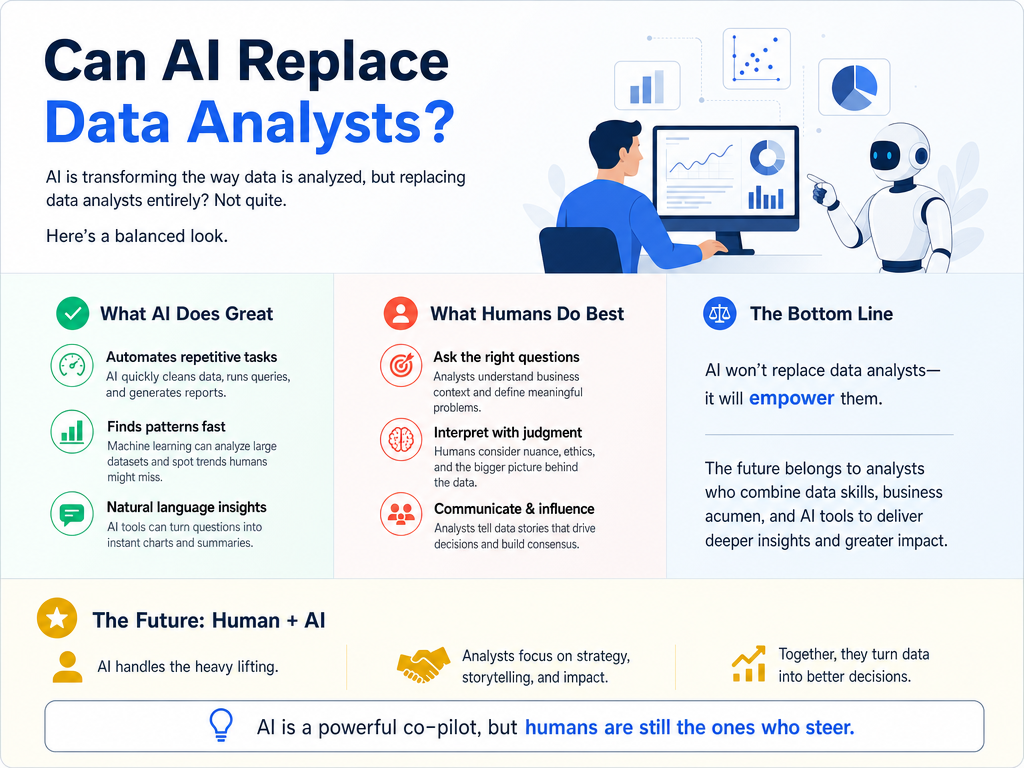
AI is transforming the way data is analyzed, but replacing data analysts entirely? Not quite. Here's a balanced look.
What AI does great
**Automates repetitive tasks.** AI quickly cleans data, runs queries, and generates reports — work that used to consume hours of an analyst's week.
**Finds patterns fast.** Machine learning can analyze large datasets and spot trends humans might miss, especially across millions of rows.
**Natural language insights.** AI tools can turn plain-English questions into instant charts and summaries, making data more accessible to everyone.
What humans do best
**Ask the right questions.** Analysts understand business context and define meaningful problems — the hardest and most valuable part of any analysis.
**Interpret with judgment.** Humans consider nuance, ethics, and the bigger picture behind the data. They distinguish meaningful insights from misleading correlations and evaluate whether the data itself can be trusted.
**Communicate and influence.** Analysts tell data stories that drive decisions and build consensus — translating findings into recommendations decision-makers actually act on.
Which jobs are most exposed?
Roles focused mainly on routine reporting are the most vulnerable to automation. If the job is pulling the same numbers into the same deck every week, AI will absorb much of that work.
The bottom line
AI won't replace data analysts — it will empower them. The future belongs to analysts who combine data skills, business acumen, and AI tools to deliver deeper insights and greater impact.
Tools like Corgage make that shift practical: ask questions about your CSV, Excel, or JSON files in plain English, and get evidence-backed answers, charts, and forecasts in seconds — no data team required. That frees you to focus on the judgment, storytelling, and decisions only you can make.
AI handles the heavy lifting. Analysts focus on strategy, storytelling, and impact. Together, they turn data into better decisions.
**AI is a powerful co-pilot, but humans are still the ones who steer.** Analysts who develop business knowledge, critical thinking, communication, and AI skills will remain highly valuable.
careersAIdata analysis
Run this analysis on your own data
Upload a CSV, Excel, or JSON file and Corgage profiles it, charts it and explains what changed. Start with free AI CSV analysis, see how Corgage works or compare plans and credits.
Start your free trialRelated data analysis guides
- Is Data Analysis a Stressful Career?
Most people can learn data analysis fundamentals in 2–4 months and become job-ready in 6–12 months by focusing on Excel, SQL, visualization, and portfolio projects.
- What Are the Best Entry-Level Data Jobs?
From Data Analyst to BI Analyst to Data Quality Analyst — a practical guide to the best entry-level data roles, what each one involves, and which fits your strengths.
- How Long Does It Take to Learn Data Analysis?
Learning data analysis to a job-ready level typically takes 3 to 12 months. Compare certificates, bootcamps, and self-taught routes — and why a portfolio of real projects matters most.