Financial Analysis in Different Industries: What's the Difference?
Corgage Team · · 1 min read
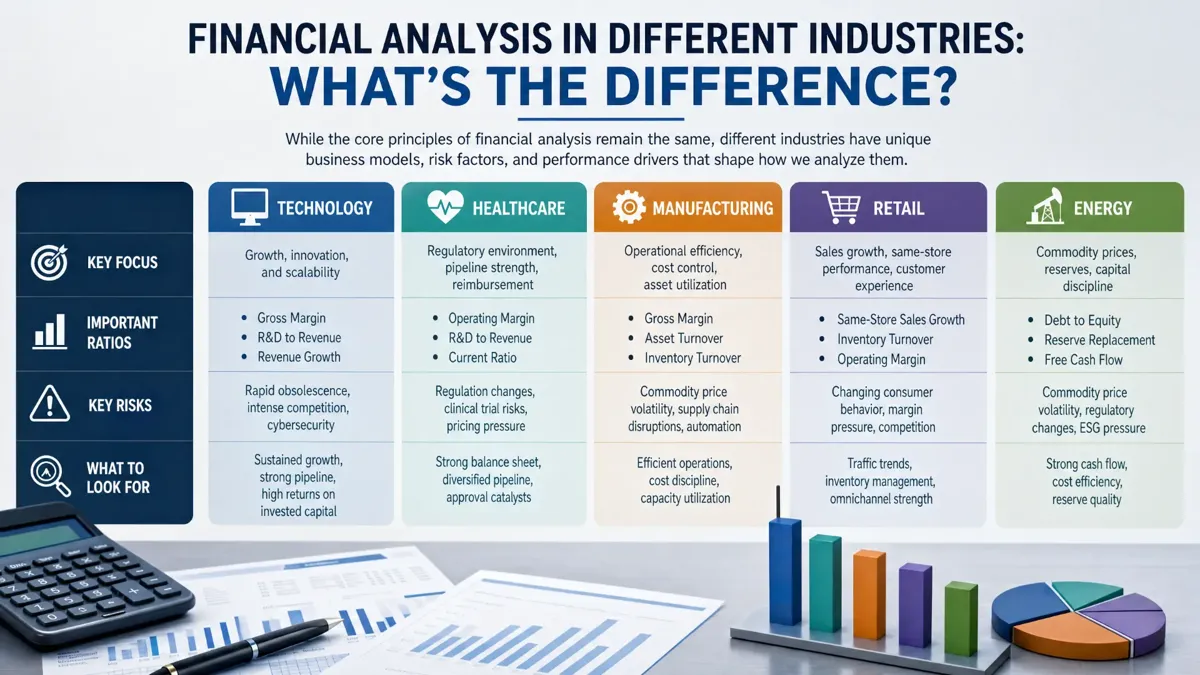
Financial Analysis in Different Industries: What's the Difference?
Financial analysis differs across industries because each sector has unique revenue models, costs, assets, risks, and regulations. Manufacturing focuses on production efficiency, inventory turnover, capacity utilization, and capital expenditure, while retail emphasizes sales growth, inventory management, and customer demand. Technology companies are often evaluated using recurring revenue, customer retention, growth rates, and scalability. Banks focus on net interest margins, loan quality, liquidity, and capital adequacy rather than traditional debt ratios. Energy, real estate, healthcare, and transportation each require industry-specific measures such as production costs, occupancy, patient revenue, or load factors. Therefore, analysts must combine standard financial ratios with sector-specific metrics to accurately assess performance and value.
Corgage helps: you can upload data from any industry and explore how the standard ratios and sector-specific metrics work together on real numbers. It is a practical way to build the cross-industry fluency that sets strong analysts apart.
Financial Analysis
Run this analysis on your own data
Upload a CSV, Excel, or JSON file and Corgage profiles it, charts it and explains what changed. Start with free AI CSV analysis, see how Corgage works or compare plans and credits.
Start your free trialRelated data analysis guides
- What Skills Do You Need to Become a Market Research Analyst?
Strong analysis, communication, and curiosity — these are the skills that make a market research analyst effective. Here is the full list to build your career on.
- How to Break Into Market Research Without Experience
You can land a market research role without experience by building practical skills, creating portfolio projects, and applying with confidence. Here is a clear, step-by-step path in.
- How Much Do Market Research Analysts Make?
A clear look at what market research analysts earn — median pay, percentile ranges, and the factors that push salaries higher.