How Much Do You Need to Invest to Make $1,000,000?
Corgage Team · · 1 min read
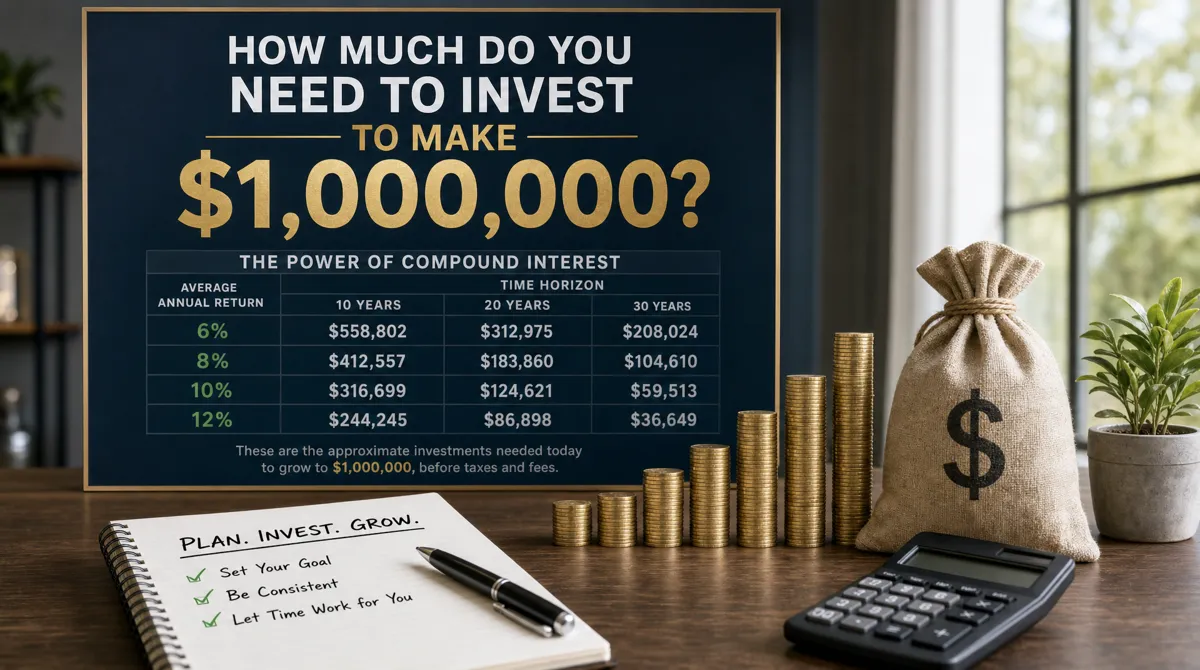
Three quick takeaways: the amount you need depends on whether you start with a lump sum or contribute regularly, and on the time horizon and assumed return. For a lump sum P growing to 1,000,000 in t years at an annual rate r, P = 1,000,000 / (1 + r)^t; e.g., about 184k at 7% for 25 years, 215k at 8% for 20 years, or 240k at 10% for 15 years. If you're saving monthly for T years at annual return r, the monthly contribution PMT is derived from FV = PMT × [((1 + i)^n − 1) / i], where i = r/12 and n = 12T; rough ballparks: around $880-$900/month for 30 years at 7%, about $720-$750/month at 8%. Remember this ignores taxes, fees, and inflation, which can significantly alter real outcomes. If you share your starting capital, monthly savings, target horizon, and a realistic net return, I'll tailor a precise plan and show several scenarios.
Corgage helps you run these same calculations on your own numbers in minutes. It helps you see exactly what to set aside each month to reach a goal like $1,000,000.
investingcompound interestpersonal financeinvestment goalsinvestment analyst
Run this analysis on your own data
Upload a CSV, Excel, or JSON file and Corgage profiles it, charts it and explains what changed. Start with free AI CSV analysis, see how Corgage works or compare plans and credits.
Start your free trialRelated data analysis guides
- Should You Pursue a Career in Investment Analysis?
Intellectual challenge, continuous learning, and competitive pay — balanced against long hours and real pressure. Here is how to decide if investment analysis fits you.
- Investment Analyst Bonus Structure: What to Expect
Bonuses depend on firm type, seniority, performance, and investment results — here is what to expect and what to clarify before accepting an offer.
- How to Evaluate Stocks Like an Investment Analyst
A step-by-step framework covering business model, financials, management quality, scenarios, valuation, and risk — so you can evaluate a stock the way an analyst does.