What Do Companies Look for When Hiring Data Analysts?
Corgage · September 8, 2026 · 2 min read
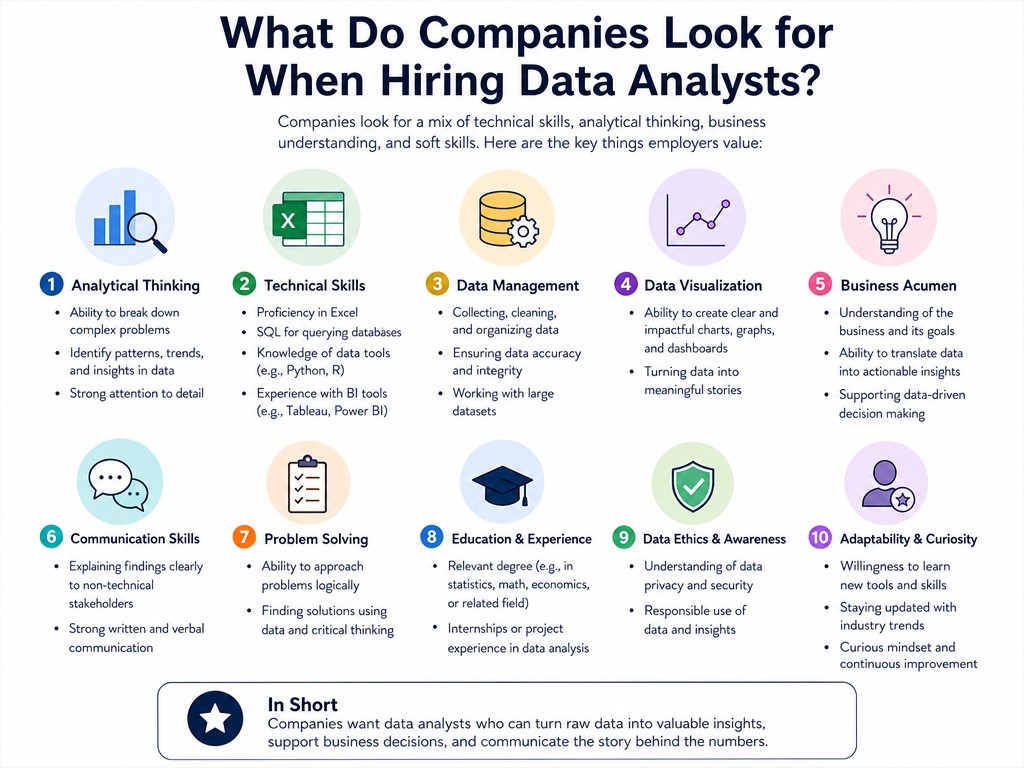
Companies look for a mix of technical skills, analytical thinking, business understanding, and soft skills. Here are the key things employers value:
- **Analytical Thinking** — ability to break down complex problems, identify patterns, trends, and insights in data, and maintain strong attention to detail.
- **Technical Skills** — proficiency in Excel, SQL for querying databases, knowledge of data tools (e.g., Python, R), and experience with BI tools (e.g., Tableau, Power BI).
- **Data Management** — collecting, cleaning, and organizing data, ensuring data accuracy and integrity, and working with large datasets.
- **Data Visualization** — ability to create clear and impactful charts, graphs, and dashboards, turning data into meaningful stories.
- **Business Acumen** — understanding of the business and its goals, ability to translate data into actionable insights, and supporting data-driven decision making.
- **Communication Skills** — explaining findings clearly to non-technical stakeholders, with strong written and verbal communication.
- **Problem Solving** — ability to approach problems logically and find solutions using data and critical thinking.
- **Education & Experience** — a relevant degree (e.g., in statistics, math, economics, or a related field) and internships or project experience in data analysis.
- **Data Ethics & Awareness** — understanding of data privacy and security, and responsible use of data and insights.
- **Adaptability & Curiosity** — willingness to learn new tools and skills, staying updated with industry trends, and a curious mindset with continuous improvement.
In Short
Companies want data analysts who can turn raw data into valuable insights, support business decisions, and communicate the story behind the numbers.
Companies hiring data analysts look for strong skills in SQL, Excel, data visualization, and basic statistics. Many also value experience with Python or R for cleaning, analyzing, and automating data tasks. Employers want candidates who can turn business questions into useful insights and make practical recommendations. Clear communication is important because analysts must explain findings to nontechnical teams. Attention to detail, problem-solving, curiosity, and the ability to work with different departments are also highly valued. A portfolio showing real projects, dashboards, and business-focused analysis can help candidates stand out.
Corgage helps you build exactly the evidence employers look for: upload real datasets, clean and analyze them in minutes, and export polished reports, charts, and presentations that become portfolio-ready proof of your analytical and visualization skills.
You can also practice predictive modeling and ask Vera, Corgage's AI assistant, to explain complex results or suggest business recommendations—helping you sharpen both your technical and communication skills before interviews.
careerdata analysthiringskills
Run this analysis on your own data
Upload a CSV, Excel or JSON file and Corgage profiles it, charts it and explains what changed. Start with free AI CSV analysis, see how Corgage works or compare plans and credits.
Start free trialRelated data analysis guides
- What Are the Best Entry-Level Data Jobs?
From Data Analyst to BI Analyst to Data Quality Analyst — a practical guide to the best entry-level data roles, what each one involves, and which fits your strengths.
- How Long Does It Take to Learn Data Analysis?
Learning data analysis to a job-ready level typically takes 3 to 12 months. Compare certificates, bootcamps and self-taught routes — and why a portfolio of real projects matters most.
- Is Data Analysis a Stressful Career?
Most people can learn data analysis fundamentals in 2–4 months and become job-ready in 6–12 months by focusing on Excel, SQL, visualization, and portfolio projects.